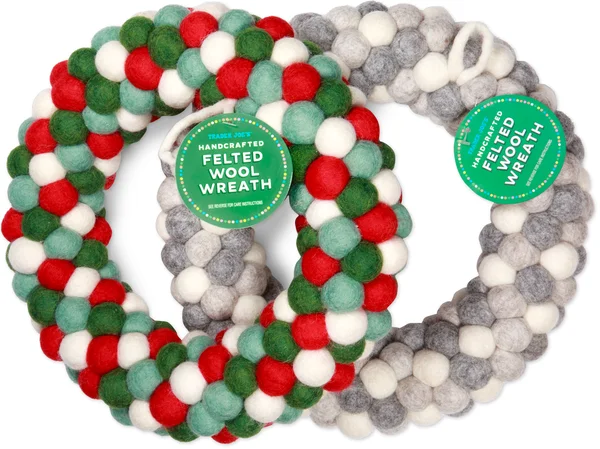
Trader Joe’s Felted Wool Wreath ($17) and six-foot Mini Garlands (~$5 each) are made from New Zealand wool hand-felted in Nepal — quality that comparable online versions sell for $18 to $30, often for less material.
Handcrafted Wool in the Home Essentials Aisle
Trader Joe’s holiday felt line centers on two items this season: the Felted Wool Wreath at $17 and the Mini Felted Wool Garland, a 6-foot strand at around $5. Both are made from New Zealand wool that is hand-felted and assembled in Nepal — a production method that gives the pieces their dense, dimensional texture rather than the flat sheen of machine-made holiday decor.
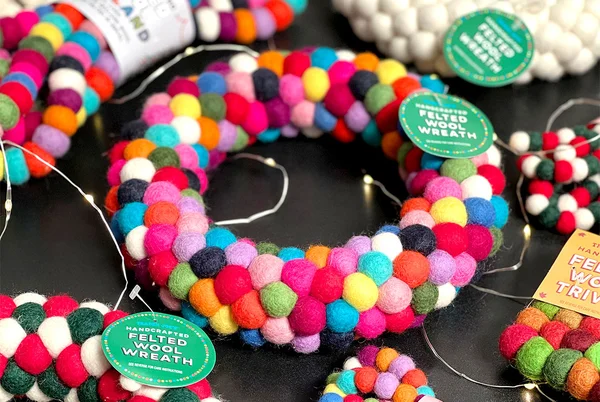
The wreath features green felt leaves with red and white ball accents — the classic wreath palette rendered in a material that holds its shape without drying out or shedding needles. The garlands come in three colorways: red, white, and green; multi-colored; and all white. The range is narrow enough to feel curated, broad enough to serve traditional, maximalist, and minimalist displays. All of it lives in the home essentials aisle, not with seasonal food, and it tends to move before most shoppers notice it has arrived.
| Price | $17 (wreath) / ~$5 each (garlands) |
| Size | Wreath: 1 each; Garlands: 6 ft each |
| Material | New Zealand wool, hand-felted in Nepal |
| Where to find it | Home essentials aisle |
| Availability | Seasonal, limited-time — no restock until next holiday season |
What ‘Handcrafted’ Actually Delivers
The genuine selling point here is tactile. Hand-felted New Zealand wool produces a dense, pom-pom-like softness — dimensional in a way that photographs cleanly and reads as premium against a shelf, a wall, or a gift box. This is not the plastic sheen of mass-market ornaments at the same price point; the material is legitimately different from anything a big-box retailer sells in this range.
The honest limitation is scale. The garlands run 6 feet — enough for a standard mantle or a table runner, not enough for a full staircase banister without buying multiple strands. The wreath is a single piece; it is not a large-format front-door statement piece. These are accents, not centerpieces. The quality holds across seasons — this is not single-use decor — but anyone expecting volume should factor in that ‘mini’ in the product name is an accurate description, not marketing modesty.
Six Ways to Style These Decorations
The most underused application is also the one Trader Joe’s recommends directly: wrapping gifts. A 6-foot length of red/white/green garland tied around a plain kraft box replaces ribbon with something dimensional and reusable. At $5 per strand, it is practical to use across a full stack of packages rather than reserving it for display. The result photographs considerably better than standard wrapping, and the garland returns to circulation the following year.
For the wreath, an interior location outperforms the front door in most cases. Scale works in its favor at a cabinet face, a mirror, a bedroom door, or a kitchen entry — places where the piece reads as an intentional accent rather than needing to anchor an entire facade. Front-door use works, but expectations about size should follow the product, not the other way around.
The standard mantle run is the third application, and it is the clearest case for buying two garland strands. A single 6-footer runs the length of a narrow mantle; two can extend onto flanking bookshelves or overlap in a loose swag at center. For added depth, draping the garland over fresh pine branches or live greenery brings contrast — the dense wool texture reads more vividly against waxy live foliage than against a bare wooden surface.
Colorway mixing deserves more deliberate planning than most people give it. The all-white garland stages as a base layer — it anchors a display without competing for attention and makes whatever sits above or alongside it read more cleanly. The red/white/green or multi-colored strand then provides the specific color hit. Running all three colorways together overworks the display; two, with one serving as the neutral, is the more resolved approach.
For a fully coordinated wool tableau, the Felted Ilex Berries and other felt accessories that Trader Joe’s frequently stocks alongside this line extend the material story without introducing a competing texture. Everything in the felt line shares the same handcrafted density — a visual coherence that is harder to achieve when mixing in satin ribbon or plastic ornaments. If the goal is a consistent handmade aesthetic, staying within the wool line is the right call.
The sixth application is the most practical for leftover garland: a tabletop ring. A 6-foot strand circles the base of a candleholder, a vase, or a small potted plant, finishing the arrangement in fifteen seconds. The all-white colorway performs best here against natural materials like unfinished wood or ceramic. It reads as deliberate rather than decorative overflow, which is what separates a styled surface from a cluttered one.
The Value Math
Glaciart One’s hand-felted pom garlands — a direct material comparison — sell for approximately $18 for a comparable length. Trader Joe’s garlands run ~$5. That is not a minor price difference; it is a 72 percent discount for a product made from the same base material by the same general production method. Buying all three garland colorways totals $15 — still below the price of a single comparable garland from most independent craft sellers.
The wreath at $17 sits at the entry point for handcrafted felt wreaths on the craft market, where comparable pieces typically open at $20 to $25 and run considerably higher. Resale listings for prior-season Trader Joe’s felt decor routinely appear in the $20 to $30 range. That tells two things: these pieces hold perceived value across seasons, and when stores sell out, the market immediately prices them above what Trader Joe’s charged. The math is straightforward — $17 at the store beats $30 from someone who already bought it.
The Honest Catch: Buy It on the First Trip
Stock is the entire variable. These are seasonal, limited-run items with no online ordering option from Trader Joe’s, which makes the store visit mandatory — and timing it right matters. The multi-colored garlands and the wreath are consistently among the most-hunted Trader Joe’s holiday finds in the home aisle each year, moving within days of hitting shelves at high-traffic locations.
The all-white garland holds on shelves longest of the three colorways. Red/white/green and multi-colored move fastest. Not every store stocks the full range, and no restock is coming within the season. Anyone planning a specific display around a particular colorway should not treat this as a low-priority errand. If the first trip yields the right items, buy what is needed. A second trip to a different location is an unreliable fallback. Next holiday season is the only guaranteed restock.
Quick Questions
Where can I find Trader Joe’s holiday felt decorations?
Home essentials aisle. Stock is limited and seasonal — availability varies by location, and popular colorways can sell out within days of arriving on shelves.
How long are Trader Joe’s felt garlands and wreaths available?
Limited time only. Once the holiday season stock sells through, these are not expected back until the following year.
What are Trader Joe’s felt decorations made of?
New Zealand wool, hand-felted and assembled in Nepal — the same production method used by independent craft makers who typically charge considerably more.
Can the garlands be used to wrap gifts?
Yes — Trader Joe’s recommends it. A single 6-foot garland ties cleanly around several packages and stores flat for reuse the following season.
At $5 per 6-foot garland and $17 for the wreath, this wool decor line is priced below the floor for comparable handcrafted felt items — the only real question is whether a specific colorway is still on the shelf when it counts.